


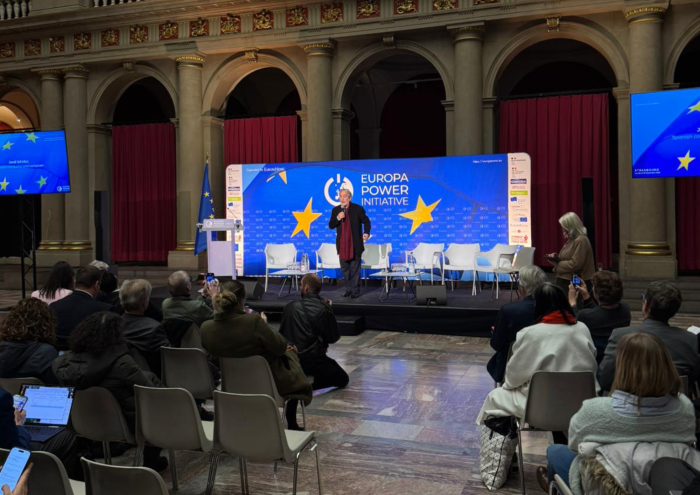
On November 26 and 27, Jordi Savall took part in the founding assembly of the Europa Power Initiative in Strasbourg, a new civic, social, and cultural movement created to strengthen sovereignty, capacity for action, and European leadership in a global context undergoing profound transformation.
The meeting brought together figures from various fields –culture, research, technology, environment, economy, and civil society– with the aim of establishing the foundations of a common agenda that positions Europe as a democratic, sustainable, and responsible power. The collective work of these sessions culminated in the drafting of the Strasbourg Declaration.
A Declaration to Rethink the Future of Europe
The Strasbourg Declaration identifies the main geopolitical, technological, and cultural challenges facing Europe and calls for overcoming fragmentation and regaining control of the collective destiny. The manifesto highlights the need to promote:
- a citizen mobilization that strengthens European democracy,
- an economic and technological agenda based on innovation, sustainability, and social cohesion,
- a common security and defence strategy,
- a strong commitment to culture, heritage, and creativity as pillars of peace and coexistence.
Among its proposals, the text supports the creation of a European Day of Culture in May and proposes an annual meeting –the Europa Power Conference– to assess the progress of this European power agenda.
Jordi Savall’s Contribution
Jordi Savall’s participation, internationally recognized for his musical and humanistic work, is part of his commitment to intercultural dialogue, the defence of peace, and the strategic value of culture as an instrument of democratic cohesion. Savall contributed to the debate by bringing the perspective of the world of arts and culture, emphasizing the importance of a European model that values creativity, heritage, and critical thinking as the foundations of a free and resilient society.
Declaration of Strasbourg, November 27, 2025
Declaration adopted at the conclusion of the constitutive assembly
of the Europa Power Initiative
Citizens of Europe and the rest of the world
to their governments,
to their social, scientific, and cultural institutions, and to their businesses.
Preamble
After the Second World War, European states designed and implemented one of the most impressive political projects in history. For nearly 75 years, it has ensured peace and prosperity within Europe and has made it a stable and benevolent partner for the rest of the world.
Today, however, Europe is accumulating geopolitical and cultural failures that call its very essence into question and leave its citizens disoriented. The fate of Ukraine, a sovereign country, is being decided by two military superpowers that make agreements at the expense of Europeans. European action on climate change, necessary for a livable future for generations worldwide, is rendered ineffective by the inability of the most powerful countries to look beyond their immediate interests. Europe’s technological sovereignty is undermined by its dependence on servers, platforms, and satellites under foreign control. Its democratic culture, based on diversity, creativity, media freedom, and respect for social human rights, is being attacked on its own soil by logics of profit, standardization, and subjugation of minds.
All these failures, setbacks, and defeats are due to the lack of willingness of our institutions to see Europe as a geopolitical, technological, and cultural power. Europeans and their partners now find themselves caught in a world order shaped by the rivalry of systemic superpowers, which prioritize imperial power and the capture of resources necessary for their technological dominance, at the expense of peace, justice, and global balance. This new reality exposes Europe – like other regions – to the immediate risk of economic, technological, cultural, and political marginalization. It undermines the very foundations of our society: freedom, democracy, pluralism, standard and quality of living, social protection, security, and European values.
In the face of this existential threat, an urgent awakening is essential: to reject any subjugation, to regain control of our destiny, and to build an ambition that is understandable both to Europeans and to the rest of the world. Individually, in this new age of superpowers, European countries will be nothing but servants. If they want to have influence, they must together rediscover a momentum for building a common power. Strengthening the union and silencing particular selfish interests will sometimes require sacrifices, but the cost of powerlessness is already far higher. Only a true change in approach can make it possible to avoid it.
Declaration
“We, free citizens of Europe and the rest of the world, must organize ourselves. Today we are launching a civic, societal, and cultural movement in favor of a democratic, global, sustainable, and responsible European power, cooperating with willing countries and with the women and men of this planet, in order to build a better world for everyone, in the interest of present and future generations. Our project is not to judge the actions of governments and diplomats at the moment. It is to evaluate each of their decisions and projects in terms of their contribution, in the short, medium, and long term, to the reconstruction of a European power capable of controlling its own destiny.
We have all the levers to make Europe a power of the future. The ideas exist, supported by numerous reports which, until now, have only been implemented very slowly and partially. It is now necessary to prioritize them and activate the levers that are within our reach in key areas.
- The first lever is the willingness of citizens to actively participate in writing a new positive chapter in the history of our continent and in shaping the future of European democracy.
- The second lever is a market of 450 million inhabitants that must be harnessed for an agenda of economic, industrial, technological, social, and environmental development in our territories, for the prosperity of all Europeans and for the cohesion of Europe.
- The third lever is a massive savings pool of €35 trillion, which, thanks to a unified savings and investment market, ambitious growth prospects, and rules that reward risk- taking, will finance our development and our industrial policy.
- The fourth lever is the decision to ensure jointly our collective security together and to develop a strong defence industry for the future. Activating this lever requires ending the fragmentation of the military capabilities and of the military procurement, programmes and research and building as soon as possible a shared vision of our defence and security with our citizens.
Our schools, universities, researchers, engineers, artists, and entrepreneurs are determined to take back the lead in shaping the future and to regain artistic, technological, and scientific leadership. Achieving this requires increased investment, an acceleration of the ongoing transformation of our systems, and a clear strategy to attract talent from around the world.
The time has come to develop the digital infrastructures essential for our collective sovereignty and crucial to harnessing the potential of artificial intelligence and quantum technologies, putting them at the service of our citizens and the future of a fair economy rich in well-paid jobs.
We also have a strong foundation in public health with remarkable innovation capacity, offering a unique opportunity to improve healthy quality of life and make health breakthroughs for the benefit of the world.
Our values, our culture, our social model, our rule of law, our sense of justice, our respect of heritage, as well as our attention to the environment and climate, make Europe a space of balance and quality of life. Furthermore, we have common institutions – imperfect but stable, adaptable, and resilient – capable of carrying out shared projects while valuing regional, national, and European identities.
Culture and heritage are strategic instruments of peace-building, social empathy, and democratic resilience, and they must be supported through accessible frameworks and protection for artists, cultural institutions, and creative communities across Europe.We encourage establishing a “European Day of Culture” in May as a shared civic moment: a day in which citizens come together with artists and institutions to highlight Europe’s cultural, humanistic, and democratic identity.
Today, the Europa Power Initiative brings together opinion leaders and civil society
actors who want to take back control of our collective destiny. It is open to those, in Europe and beyond, who reject an international order dictated solely by an imperialist view of spheres of influence. This strong and prosperous Europe must be co-constructed by citizens, businesses, trade unions, civil society, European and national institutions, local authorities, as well as international partners, regardless of their size or power, ready to cooperate in a spirit of respect and dialogue for the sake of a better world.
This is the roadmap of the Europa Power Initiative. We invite everyone who wishes to join us in building this progressive agenda and making Europe a systemic, global, sustainable, and responsible power, putting citizens at the heart of its actions.
We propose establishing an annual meeting on the topic of power: the Europa Power Conference. Each edition will allow public assessment of progress, evaluation of decisions made, and updating of the roadmap, so that the power agenda remains a living and verifiable process.
European power is a positive, innovative, free, attractive, social, and humanist future. It is not a given, it cannot be decreed, it must be built. It depends on our collective ability to come together and take action.”


Share